
New for 2026Accreditation 360 · virtual tracer
A surveyor just walked into your facility.
Under Accreditation 360, surveyors don’t read your binders — they follow your instruments and ask your team to explain what they do and why. This is a seven-minute version of that walk: one tray, six stops, the questions surveyors actually ask. Answer as yourself. At every stop you’ll see what the surveyor expects to hear — and where they would have pressed.
- 09:38Point of use
- 09:41Transport
- 09:52Decontam
- 10:24Prep & pack
- 10:51Sterilization
- 11:15Storage
Begin here · seven minutes
The surveyor’s first question is simple: who are they talking to?
Seven minutes. No score theater — a readiness read, station by station.
01 · The model
What Accreditation 360 actually changed
The Joint Commission announced Accreditation 360 on June 30, 2025, and it took effect January 1, 2026. It is the largest rewrite of hospital accreditation in decades — and the part that matters most to your team is not the number of standards that disappeared, but what surveyors now expect to see instead.
Before and after, in four lines
This isn’t about easing up on expectations. It’s about removing redundancy and focusing squarely on consistency, accountability and outcomes.
What did not change
The survey method. Surveyors still trace: they follow a patient, a process, or an instrument across department boundaries and ask the people doing the work to explain it. The Document Review Tool, the building tour, and the SAFER matrix — which scores every finding by likelihood of harm and how widely the pattern shows — are all still in use. Fewer standards did not mean fewer questions. It meant the questions land on people instead of binders.
02 · The goals
The 14 National Performance Goals
Effective January 1, 2026, these replaced the National Patient Safety Goals — the organizing spine of the new manual and the frame surveyors work from.
- 01
Right patient, right care
- 02
Culture of safety
- 03
Emergency management
- 04
Excellent health outcomes for all
- 05
Infection prevention and control
The goal this walk lives inside — infection prevention is where sterile processing, transport, and storage meet the survey.
- 06
Pain management
- 07
Patient rights
- 08
Suicide risk reduction
- 09
Safe transplant practices
- 10
Waived (point-of-care) testing
- 11
Workplace and patient safety
- 12
Planning and evaluating provision of care
- 13
Imaging safety
- 14
Medication management
Read all 14 in plain language
- Right patient, right care. The hospital ensures that the correct patient receives the correct care at the correct time.
- Culture of safety. The governing body and leadership team foster a culture of safety.
- Emergency management. The hospital has an emergency management program.
- Excellent health outcomes for all. The hospital prioritizes excellent health outcomes for all.
- Infection prevention and control. The hospital prioritizes infection prevention and control.
- Pain management. The hospital prioritizes pain management and safe prescribing practices.
- Patient rights. The hospital respects the patient’s right to safe, informed care.
- Suicide risk reduction. The hospital reduces the risk for suicide.
- Safe transplant practices. The hospital develops and implements safe transplant practices.
- Waived (point-of-care) testing. The hospital performs waived testing in a safe and consistent manner.
- Workplace and patient safety. The hospital maintains workplace and patient safety.
- Planning and evaluating provision of care. The hospital is staffed to meet the needs of the patients it serves, and staff are competent to provide safe, quality care.
- Imaging safety. The hospital safely performs imaging services.
- Medication management. The hospital has a medication management program that focuses on safety.
Source: The Joint Commission, 2026 National Performance Goals. Plain-language summary by Surgical Solutions.
03 · The questions
What surveyors are actually asking
The questions our clinical team hears again and again — asked plainly, of whoever happens to be standing there.
Surveyors often ask very practical questions about everyday processes. They want to understand exactly how teams handle sterilization, instrument inspection, and infection control.
How are instruments transported from the OR to sterile processing?
Asked at 09:41 · Transport
How do you verify instruments are clean before sterilization?
Asked at 09:52 · Decontamination
How do you ensure sterilization parameters are met?
Asked at 10:51 · Sterilization
What steps do you take if a sterile package becomes compromised?
Asked at 11:15 · Sterile storage & return
You will answer all four in the walk — and see what a surveyor expects to hear.
04 · The field
Where surveyors are pressing in 2026
Five patterns our team is seeing in the field this year.
Instructions for use — reachable, not just present
Not whether IFUs exist, but whether staff can pull the right one mid-workflow.
Packaging decisions made on criteria, not habit
Peel pack or wrapped set — decided by weight limits and suitability, not preference.
Instrument condition
Rust, nicks, debris, tape residue: a compromised instrument leaves service, documented.
Life safety as everyone’s responsibility
Extinguishers, exits, and emergency procedures are fair questions for anyone, anywhere.
Infection prevention, consistent across shifts
Nights and weekends must look like Tuesday morning — shift variation becomes a pattern finding.
05 · The check
A four-question readiness check
Before the walk, a quick gut check from our team. Can the people doing the work:
- Explain your water monitoring process — the frequency, the parameters, and why they matter?
- Walk a surveyor through your most recent biological indicator failure, step by step?
- Say how your department connects to the National Performance Goals?
- Describe what changed in their workflow under Accreditation 360, and what training followed?
If any of those produced a pause, that pause is what the tracer is designed to find.
06 · The kit
The readiness kit comes with your findings
Three field documents built with our clinical team: the one-page readiness checklist, all 14 National Performance Goals in plain language, and the in-depth survey readiness guide for OR, sterile processing, and infection prevention leaders. They arrive with your report at the end of the walk.
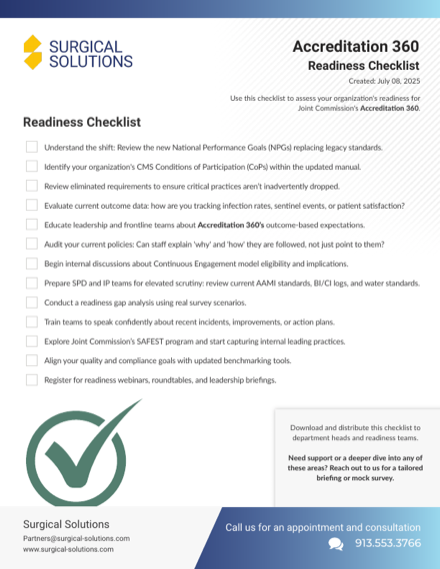
Accreditation 360 readiness checklist
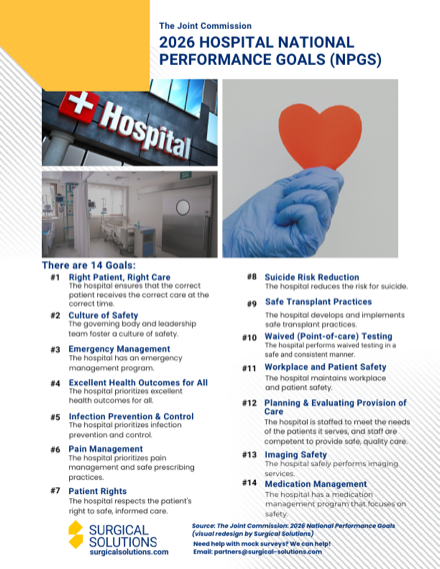
2026 Hospital National Performance Goals
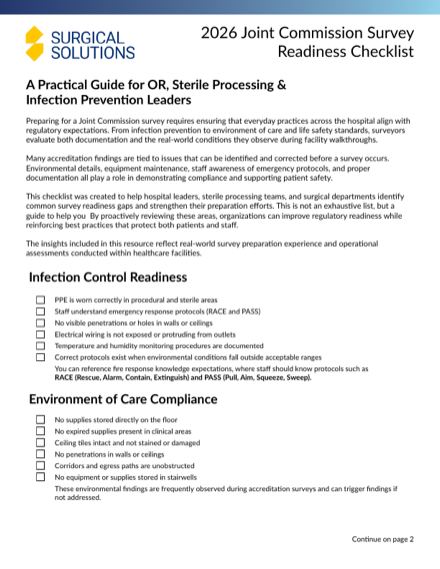
2026 Joint Commission Survey Readiness Checklist
07 · The series
The Accreditation 360 series
Everything our team has published on the new model, in the order we would read it.
 Part 1
Accreditation 360: a new era of Joint Commission healthcare accreditation
The overview: what the model is, what was eliminated, the shift from documentation to demonstration, and what leaders should do about it.
Read the article Part 2
What hospitals need to know about 2026 accreditation changes
Field-level detail: IFU access, packaging decisions, instrument inspection, life safety, and how the National Performance Goals reshape preparation.
Read the article Part 3
What Joint Commission surveyors are really asking in sterile processing
Robin Evans on the questions that actually get asked in SPD — instrument condition, corrosion, documentation gaps, transport and storage.
Read the articleRelated reading
Reading about it is not the same as being asked.
The walk takes about seven minutes: one instrument tray, six stops, and the questions above put to you the way a surveyor would put them. You will see what they expect to hear at every stop, and where they would have pressed.